
Imagine you have saved around ₹25 lakh and want to build something more tangible than another trading or service business.
You do not want to invest crores in land. You do not want a factory with 50 employees from day one. You simply want a manufacturing business where you can start at a manageable scale, understand the market, build customers and expand once the numbers begin to make sense.
This is where many first-time entrepreneurs make their first mistake.
They start searching for “machines under ₹25 lakh” instead of searching for a manufacturing business that can actually operate successfully within a ₹25 lakh investment.
There is a big difference.
A machine costing ₹8 lakh does not mean the business requires only ₹8 lakh. You may still need ₹2 lakh for electrical installation, ₹1 lakh for deposits, ₹3 lakh for raw material, ₹2 lakh for packaging and several lakhs for salaries, transport and customer credit.
That is why the better question is not:
“Which manufacturing machine can I buy for ₹25 lakh?”
The better question is:
“Which manufacturing business can I realistically start, operate and sell from with a budget of around ₹25 lakh?”
In India, this investment range opens up several possibilities across packaging, food processing, industrial products and consumer goods. But every opportunity needs to be evaluated through four basic factors: machinery, raw materials, customers and working capital.
This guide examines some manufacturing business ideas that deserve serious research if your investment range is around ₹10 lakh to ₹25 lakh.
Can You Really Start Manufacturing With ₹25 Lakh?
Yes, but only if the project is structured correctly.
A ₹25 lakh budget is more suitable for a small manufacturing unit operating from a rented industrial shed than a project where land must also be purchased. It generally works better for established manufacturing processes where machines are readily available in India and production can begin with semi-automatic equipment.
India’s current MSME classification allows a micro enterprise to have investment in plant and machinery or equipment of up to ₹2.5 crore and turnover of up to ₹10 crore. A ₹25 lakh manufacturing project therefore falls comfortably within the micro-enterprise segment.
However, ₹25 lakh should not automatically be treated as the total amount needed for every project.
Your actual investment may include:
- Machinery and equipment
- Rent deposit and shed preparation
- Electrical installation
- Raw-material inventory
- Packaging materials
- Labour
- Licences and registrations
- Transportation
- Marketing and distribution
- Working capital
In many businesses, working capital can become almost as important as the machine itself.
1. Paper Bag Manufacturing
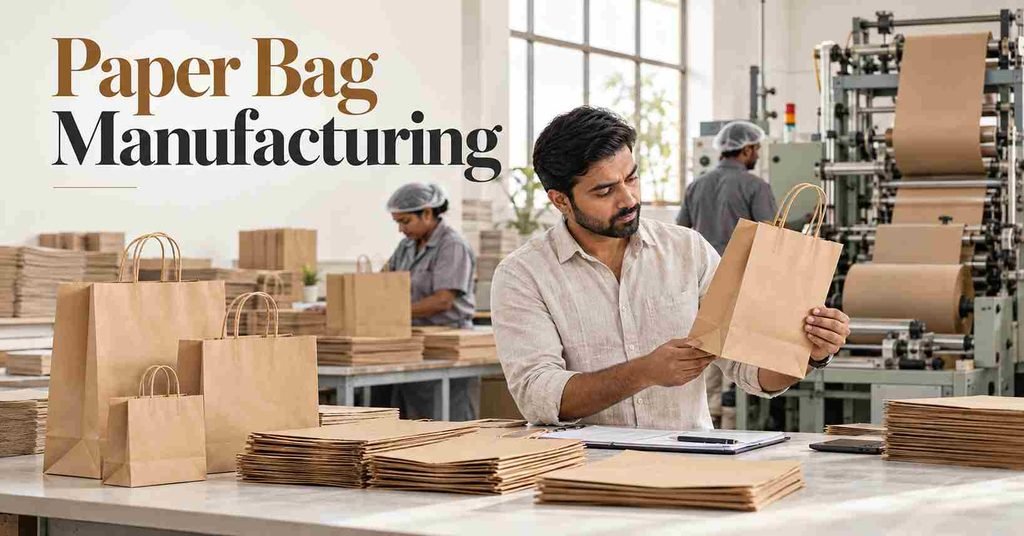
Paper bag manufacturing is one of the simpler opportunities to understand because the final product already has buyers across several industries.
A paper bag unit can supply pharmacies, bakeries, food outlets, clothing stores, jewellery shops, gift stores and other retailers.
An earlier government model project estimated the investment for a small paper bag unit at approximately ₹15.06 lakh. Of this, around ₹6.49 lakh was allocated to plant and machinery, while more than ₹8 lakh was associated with working capital requirements.
That difference is important.
It demonstrates that buying the machine is only part of the business.
Typical machinery may include a paper bag making machine, cutting and creasing equipment, printing equipment and supporting tools depending on the product range.
The entrepreneur should first determine what type of bags local customers actually use.
For example, a pharmacy may require a simple low-cost paper bag, while a premium clothing store may require thicker paper, handles, multicolour printing and customized dimensions.
Your product mix directly affects machinery, raw-material cost and selling price.
Before setting up the unit, identify at least 15 to 20 potential customers and ask about their monthly consumption, GSM requirement, bag dimensions, printing needs and existing purchase price.
Paper bag manufacturing becomes more interesting when you are solving a specific packaging requirement instead of simply manufacturing generic bags and hoping someone will buy them.
2. Spice Grinding and Packaging
Spice processing is another manufacturing business that can be explored within this investment range.
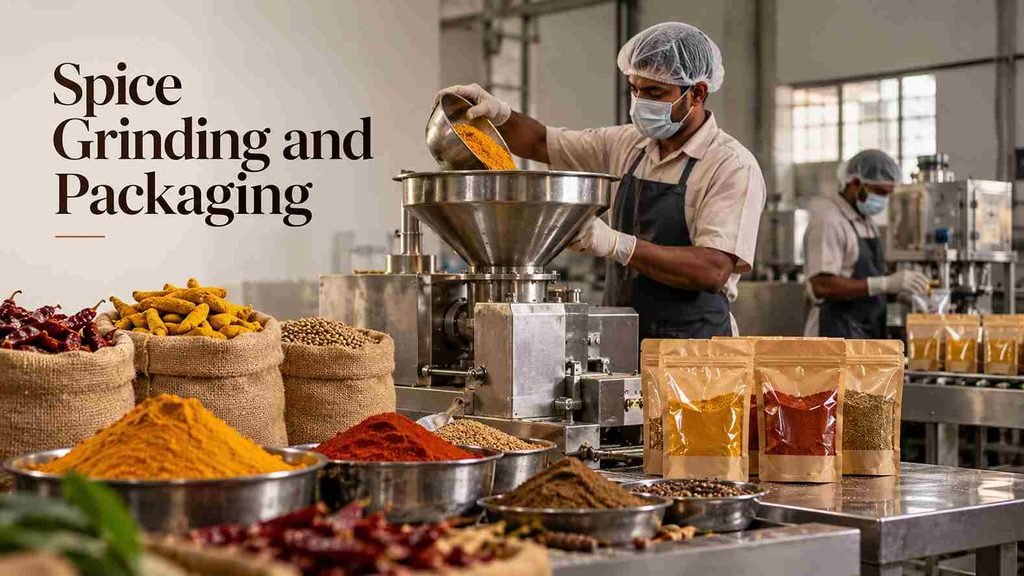
A small plant may process turmeric, coriander, chilli, cumin and blended masalas depending on the business model.
A model spice-grinding project has previously been estimated at around ₹15.55 lakh, including approximately ₹9.86 lakh for plant and machinery and around ₹4.44 lakh for working capital.
India also has a large spice industry. During FY 2025-26, the country exported approximately 17.34 lakh tonnes of spices and spice products worth about ₹39,140 crore.
That number shows the size of the ecosystem, but it does not automatically mean a new local spice brand will succeed.
The challenge in spice manufacturing is often not grinding.
It is selling.
An entrepreneur needs to decide whether the business will operate as:
- An own consumer brand
- A regional wholesale supplier
- A private-label manufacturer
- A restaurant and hotel supplier
- A bulk spice processor
- An institutional supplier
A processing unit may require cleaning equipment, pulverizers, grinders, sieving systems, blending equipment and packing machines.
Product quality is extremely important. Moisture, contamination, colour, aroma, particle size and consistency can directly affect repeat orders.
Food businesses also need applicable FSSAI registration or licensing.
If you already have access to wholesale markets, supermarkets, restaurant chains or distributors, spice manufacturing becomes significantly more practical than starting with no distribution network.
3. Corrugated Box Manufacturing
Corrugated boxes are not glamorous products, but that is exactly why many entrepreneurs overlook them.
Almost every physical-product business requires packaging.
Corrugated boxes are used by electronics companies, FMCG manufacturers, food processors, pharmaceutical businesses, automobile-component suppliers, online sellers, distributors and exporters.
One small corrugated-box model project was estimated at approximately ₹24.84 lakh. Around ₹15.65 lakh was allocated to machinery and more than ₹8 lakh to working capital.
This opportunity therefore sits very close to the ₹25 lakh investment ceiling.
A new entrepreneur should not assume that a complete modern corrugated-board manufacturing line can always be established for ₹25 lakh today.
A smaller entry strategy may be more practical.
Instead of producing corrugated board from the beginning, a business could purchase corrugated sheets and focus on box conversion, slotting, stitching, printing and customized supply.
That approach may reduce initial machinery requirements.
The biggest advantage of corrugated packaging is its B2B nature.
A single reliable industrial customer may purchase thousands of boxes each month.
At the same time, margins can be sensitive to kraft paper prices, transportation cost, wastage, customer specifications and credit periods.
This business deserves research particularly if you are located close to an industrial cluster where dozens or hundreds of manufacturers operate within a manageable delivery radius.
4. Wire Nail Manufacturing
Wire nails are used across construction, furniture manufacturing, carpentry, wooden packaging, pallets, hardware distribution and several small industrial applications.
An earlier model project estimated the investment required for a wire-nail unit at around ₹18.64 lakh.
Interestingly, only about ₹3.48 lakh was allocated to plant and machinery while the working-capital estimate was more than ₹11 lakh.
This makes wire nails an excellent example of why machinery cost can be misleading.
You may find an affordable manufacturing machine, but significant money can become blocked in steel-wire inventory, finished stock and customer receivables.
The business may involve nail-making machines, polishing equipment, cutters and related supporting systems.
Finished-steel consumption in India increased approximately 8.3% year-on-year during the first quarter of FY 2026-27. Infrastructure and construction-related industrial output also recorded growth during the period.
These numbers provide a useful broader demand signal, but local demand still needs validation.
Before setting up a nail unit, speak with hardware wholesalers, construction suppliers, pallet manufacturers and furniture clusters.
Find out which nail sizes move fastest.
A factory producing the wrong mix of sizes can have a running machine but slow-moving stock.
5. Agarbatti Manufacturing
Agarbatti manufacturing has been a traditional small-scale manufacturing business in India for decades.
A small unit can be started with comparatively limited machinery.
One model project estimated the total investment at approximately ₹7.57 lakh, including roughly ₹5.70 lakh for plant and machinery.
This makes agarbatti one of the lower-investment businesses on this list.
Typical raw materials can include bamboo sticks, charcoal powder, binding materials, fragrance compounds and packaging material.
Depending on your strategy, you may manufacture raw agarbatti sticks, perfumed finished products or both.
However, easy manufacturing also means relatively easy market entry for competitors.
There are already national brands, regional brands, private labels and thousands of small manufacturers.
That means your advantage cannot simply be “we manufacture agarbatti.”
You need differentiation.
It may come from fragrance, packaging, pricing, regional distribution, religious-product stores, contract manufacturing or private-label supply.
For many small entrepreneurs, supplying established distributors under their labels may be easier than spending heavily on building a new consumer brand.
6. Pickle and Regional Food Processing
Food processing is another segment where manufacturing can be started at a relatively modest scale.
A pickle-processing unit can manufacture mango pickle, lemon pickle, chilli pickle, mixed vegetable pickle and several regional variants.
One detailed model project placed the overall investment for a small pickle unit at around ₹23.01 lakh. The model included approximately ₹10.39 lakh in machinery and equipment and around ₹6 lakh in working capital.
The plant may involve washing, sorting, cutting, mixing, curing, filling, sealing and packaging processes.
The business becomes especially interesting when the entrepreneur already has access to agricultural raw materials or understands a regional recipe with existing demand.
The sales model can include:
- Retail packs
- Private-label manufacturing
- Hotel and restaurant packs
- Institutional supply
- Regional distribution
- Bulk supply
Food processing requires strong attention to hygiene, formulation consistency, shelf life and packaging.
It is also important to understand the difference between producing a good pickle and building a successful pickle business.
The second requires distributors, retailers, product rotation, packaging design and repeat customer demand.
7. Cold-Pressed Coconut Oil Manufacturing
Cold-pressed coconut oil can serve food, retail and selected wellness markets.
A small model project for cold-pressed coconut oil was previously estimated at around ₹12.39 lakh. Approximately ₹6.80 lakh was allocated to plant and machinery, while around ₹4.44 lakh was considered for working capital.
Copra quality is one of the most important variables in the business.
The location of the plant therefore matters.
A manufacturing unit close to reliable coconut-producing regions may have a different cost structure than a unit purchasing copra from distant suppliers and paying additional freight.
The production economics depend on several factors:
- Copra purchase price
- Moisture level
- Oil recovery percentage
- Electricity consumption
- Packaging format
- By-product utilization
- Labour
- Transportation
If the plant purchases raw material at the wrong price or achieves poor oil recovery, the financial projections can change significantly.
This is why an entrepreneur should conduct actual production trials or obtain realistic recovery assumptions before preparing the DPR.
8. Corn Puff and Extruded Snack Manufacturing
Packaged snacks are another manufacturing segment that can potentially fit this investment category.
A small corn-puff unit was previously estimated at approximately ₹23.66 lakh, including around ₹14.20 lakh for machinery and approximately ₹8.11 lakh in working capital.
The same project configuration indicated a power requirement of around 50 HP.
This is an important detail.
A ₹25 lakh manufacturing project does not always mean a tiny home-based unit. Some businesses within this investment range still require proper industrial electrical infrastructure.
The process may include extrusion, seasoning, oil application and packaging.
Raw materials can include corn grits, edible oil, seasoning ingredients and packaging films.
Once again, the difficult part is not only manufacturing.
Packaged-food businesses require distribution.
If a distributor takes a margin, a retailer takes another margin, promotional schemes are offered and transportation is added, the actual factory realization can be significantly lower than the printed MRP.
An entrepreneur should therefore prepare the selling-price structure before finalizing the machine.
Case Study: A ₹25 Lakh Entrepreneur Choosing Between Two Manufacturing Businesses
Consider an entrepreneur with ₹25 lakh available for a manufacturing project.
He initially shortlists two businesses:
Corrugated boxes and wire nails.
At first, corrugated boxes appear more attractive because there are several manufacturers in his local industrial area.
He receives a machinery quotation of approximately ₹16 lakh.
Wire-nail machinery, on the other hand, appears much cheaper.
The entrepreneur initially assumes wire nails must therefore be the safer project.
But when he studies the businesses properly, the picture changes.
The wire-nail project requires substantial steel-wire inventory and wholesalers expect 30 to 45 days of credit.
The corrugated-box opportunity requires more expensive machinery, but three nearby factories are willing to discuss monthly supply contracts.
Instead of choosing purely on machinery price, he compares:
- Confirmed customer demand
- Raw-material purchase terms
- Monthly production capacity
- Credit period
- Transportation cost
- Working-capital cycle
- Machinery utilization
- Break-even production
The exercise shows why “cheapest machine” and “better manufacturing opportunity” are not the same thing.
A proper manufacturing decision begins with the market and works backwards toward the machine.
Do Not Spend Your Entire ₹25 Lakh on Machinery
This deserves special attention.
If your total available capital is ₹25 lakh, spending ₹22 lakh on machinery can put the business under financial pressure before production even begins.
Suppose you spend:
₹16 lakh on machinery.
Then another ₹1.5 lakh goes into electrical work and installation.
A rent deposit and initial shed modification require ₹1 lakh.
You purchase ₹3 lakh of raw material.
Packaging, licences, testing and miscellaneous expenses require another ₹1 lakh.
You now have only ₹2.5 lakh remaining.
If customers demand 30 days of credit, that amount may not support even one complete operating cycle.
This is why working capital must be calculated separately.
A manufacturing unit can be profitable on paper and still run out of cash.
Which Business Should You Choose?
There is no single manufacturing business under ₹25 lakh that is right for everyone.
Your background can matter more than the machine.
A person already supplying industrial companies may have an advantage in corrugated boxes or hardware products.
Someone from a food-distribution family may be better positioned for spices or snacks.
An entrepreneur near agricultural raw-material sources may have an advantage in food processing or edible oils.
Before selecting a business, answer these questions:
- Who will buy the product?
- What quantity can they realistically purchase?
- What specification do they need?
- What price are they currently paying?
- Who supplies the raw material?
- How many days of inventory are required?
- How many days of credit will customers expect?
- How much does the machine produce per shift?
- What capacity utilization is realistic during the first year?
- How much working capital will the plant require?
If you cannot answer these questions, you are probably not ready to buy machinery.
Government Support for Small Manufacturing Businesses
Manufacturing entrepreneurs can also examine government-supported financing schemes.
Under PMEGP, the maximum admissible project cost for a new manufacturing enterprise is currently ₹50 lakh.
For general-category applicants, the beneficiary contribution is generally 10% of project cost. Eligible special categories can have a lower beneficiary contribution of 5%.
Margin-money subsidy percentages vary according to category and whether the unit is located in an urban or rural area.
However, entrepreneurs should never prepare a project assuming that a subsidy is guaranteed.
Eligibility, documentation, bank appraisal and scheme conditions must be checked before the benefit is included in the final financial model.
Credit-guarantee mechanisms such as CGTMSE may also support eligible MSE loans through participating lenders. This does not mean CGTMSE directly gives money to entrepreneurs. It provides guarantee support to eligible lending institutions under applicable conditions.
Licences and Compliance
The licences required depend entirely on the manufacturing activity.
Food-processing businesses may require FSSAI registration or licensing.
Industrial units may require applicable pollution-control permissions, factory-related registrations, fire approvals, electricity-related permissions or local authority approvals depending on the state, manufacturing process and scale.
Certain products may also fall under mandatory BIS or Quality Control Order requirements.
Never copy a generic licence checklist from another business.
A spice unit, wire-nail plant and packaging factory can have completely different compliance requirements.
Regulatory applicability should be checked before machinery is ordered because licences can affect plant layout, pollution-control equipment, testing requirements and overall investment.
Final Investment Readiness Checklist
Before investing ₹25 lakh in any manufacturing project, verify:
- At least 10 to 20 potential customers
- Current market selling price
- Competitor pricing
- Two or three machinery quotations
- Actual production capacity
- Expected first-year capacity utilization
- Raw-material supplier quotations
- Raw-material credit terms
- Customer credit period
- Production wastage
- Electricity requirement
- Factory area requirement
- Labour requirement
- Packaging cost
- Transportation cost
- Applicable licences
- Working-capital requirement
- Break-even production volume
- Machinery service support
- Spare-parts availability
Do this before paying a major machinery advance.
Conclusion
A ₹25 lakh budget can open the door to real manufacturing opportunities in India.
Paper bags, spices, corrugated boxes, wire nails, agarbatti, pickles, cold-pressed coconut oil and extruded snacks are examples of businesses that can be explored at MSME scale.
But the final decision should never be based only on an online list of “profitable manufacturing businesses.”
A business with ₹7 lakh machinery can require more working capital than one with ₹15 lakh machinery. A factory with excellent margins on paper can struggle because customers do not buy enough volume. Another business with moderate margins may work better because the entrepreneur already has buyers.
The correct sequence is simple:
Discover the opportunity – Understand the market – Research the costs – Evaluate the economics – Plan the investment.
That is the point where a manufacturing idea starts becoming an actual project.
Ready to Research a Manufacturing Opportunity?
If you have shortlisted a manufacturing business and want to understand its machinery, raw materials, market demand, estimated CAPEX, operating costs and project feasibility, Green CapEx can help you move from an idea to structured project research.
Explore a ₹799 Manufacturing Opportunity Report
Get a Standard DPR for your shortlisted project
Request a Custom DPR for a location-specific manufacturing project
Green CapEx – Discover. Research. Evaluate. Plan.