
A few years ago, imagine an Indian engineering company operating a packaging line imported from Europe. The machine itself works well, but one small precision component fails. Production stops.
The replacement component is not available locally. The manufacturer has to contact the overseas supplier, obtain a quotation in foreign currency, wait for international shipping and clear the part through customs. What looks like a small component worth a few thousand rupees ends up causing days, sometimes weeks, of production disruption.
Now imagine an Indian MSME manufacturing the same component locally, maintaining dimensional accuracy, meeting the buyer’s quality requirements and delivering it within 48 hours.
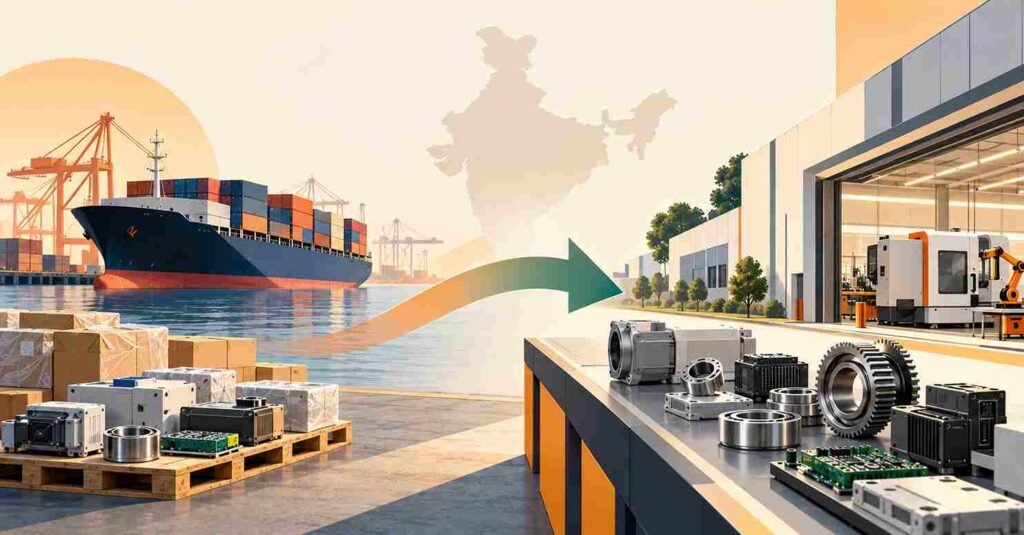
That is where import substitution becomes interesting.
Import substitution is often discussed at a national level using large numbers such as India’s trade deficit, foreign exchange savings or manufacturing self-reliance. For an MSME entrepreneur, however, the real opportunity is much more practical.
The question is not:
“How can India stop importing?”
The better question is:
“Which imported product, component or industrial input can an Indian MSME manufacture competitively for customers who already need it?”
India imported roughly US$775 billion worth of merchandise during FY2025-26. Even after excluding large categories such as petroleum and precious commodities, the country continues to import hundreds of billions of dollars worth of machinery, electronics, components, chemicals, medical equipment, industrial materials and intermediate goods.
Only a small part of this import basket may be suitable for an individual MSME.
But even a very small share can represent a meaningful manufacturing opportunity.
The challenge is finding the right product.
What Import Substitution Really Means for an MSME
Import substitution means manufacturing within India a product that Indian buyers currently purchase partly or substantially from overseas suppliers.
For a large industrial company, this could involve setting up a semiconductor fabrication facility, battery-cell plant, specialty chemical complex or solar-wafer manufacturing unit.
For an MSME, the opportunity is usually different.
An MSME may manufacture:
- A precision-machined component used in imported machinery
- A connector or cable assembly used by an electronics manufacturer
- An industrial mould or die
- A medical-device component
- A fabricated enclosure
- A polymer component
- A specialized fastener
- A sensor housing
- A machine replacement part
- A small electrical assembly
- An industrial consumable
This distinction is important.
An entrepreneur does not need to replace an entire imported product.
Sometimes the better opportunity is to replace one component inside it.
A machine costing ₹2 crore may contain hundreds of individual components. If Indian factories are operating 500 such machines and repeatedly importing particular replacement parts, there may be an opportunity for a specialized domestic manufacturer.
This is one reason import substitution can suit Indian MSMEs.
Small manufacturers can often work with lower production volumes, customized specifications and faster development cycles than very large companies.
Why Import Substitution Is Becoming More Relevant
India’s manufacturing ecosystem has expanded substantially across electronics, automobiles, pharmaceuticals, renewable energy, machinery, electrical equipment and industrial products.
As finished-product manufacturing grows, demand for components grows with it.
India’s MSME sector already contributes roughly one-third of the country’s manufacturing output and close to half of merchandise exports. That means MSMEs are not operating outside India’s manufacturing system. They are already an important part of it.
The next opportunity is deeper localization.
Consider electronics.
India has become a major electronics manufacturing location, but many important components are still sourced internationally. Printed circuit boards, connectors, display components, capacitors, camera modules, cells, magnets and several electronic inputs continue to receive policy attention because domestic supply remains limited in many categories.
A similar situation exists in several other industries.
India manufactures pharmaceutical formulations at scale but continues to work on localization of selected APIs, key starting materials and intermediates.
India has rapidly expanded solar-module manufacturing but still depends on imported materials and upstream components in parts of the value chain.
India manufactures a wide range of machinery but continues importing specialized machine tools, automation systems and precision components.
The opportunity for MSMEs is therefore moving from simply manufacturing finished products toward becoming part of these deeper industrial supply chains.
Import Substitution Does Not Mean Every Imported Product Is a Business Opportunity
This is one of the most important distinctions an entrepreneur should understand.
Suppose India imports ₹1,000 crore worth of a particular product every year.
At first glance, it looks attractive.
But why is India importing it?
Perhaps only two multinational companies buy the product, and both use approved global suppliers.
Perhaps the manufacturing technology is protected by patents.
Perhaps China produces the product at such large scale that an Indian MSME cannot compete on price.
Perhaps the main raw material itself has to be imported.
Perhaps customers require five years of technical experience before approving a vendor.
Perhaps the product requires a ₹100 crore plant even though the apparent market looks attractive.
Import value is therefore only the beginning of research.
It is not the investment decision.
A serious import-substitution study should investigate five things together:
Import demand + Indian customers + domestic competition + manufacturing feasibility + project economics
When all five support the opportunity, deeper feasibility analysis becomes worthwhile.
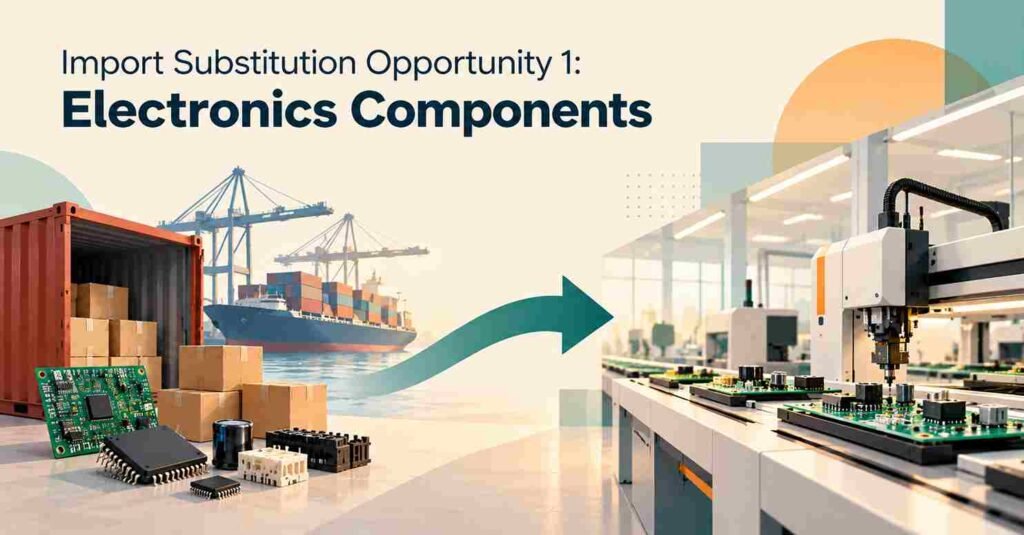
Import Substitution Opportunity 1: Electronics Components
Electronics is one of the most visible localization opportunities in India.
The country has developed a large electronics manufacturing ecosystem covering mobile phones, consumer electronics, telecom equipment, automotive electronics and industrial electronics.
Government programmes supporting electronics-component manufacturing have also accelerated investment. Approved projects under the Electronics Components Manufacturing Scheme have represented investments running into tens of thousands of crores.
However, the MSME opportunity should not automatically be interpreted as semiconductor manufacturing or lithium-ion cell production.
Those projects can require advanced technology and very high capital investment.
An MSME should instead examine secondary and supporting components.
Examples worth researching may include:
- Connectors
- Cable assemblies
- Mechanical housings
- Plastic moulded parts
- PCB-related assemblies
- Heat-management components
- Small electrical assemblies
- Testing fixtures
- Precision metal components
- Equipment enclosures
The advantage is that an entrepreneur may already possess part of the required capability.
For example, an existing injection-moulding company serving the automotive industry may be able to develop components for electronics manufacturers after upgrading moulds, quality systems and production control.
The opportunity is therefore not always about starting a new factory from zero.
Sometimes it is about using an existing manufacturing capability to enter a new supply chain.
Import Substitution Opportunity 2: Precision Engineering and Machinery Components
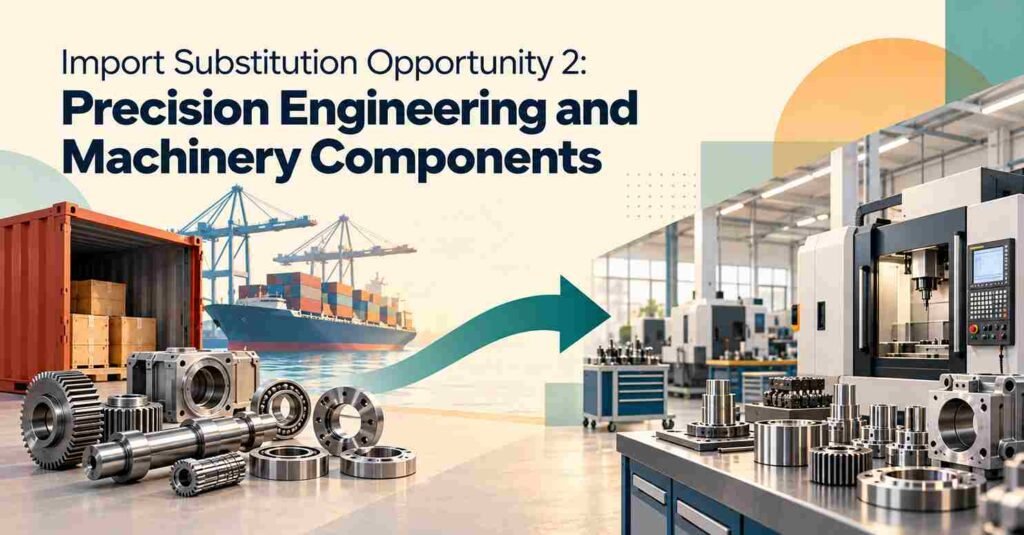
Precision engineering may be one of the most practical import-substitution areas for existing MSMEs.
Indian factories operate thousands of machines imported from Germany, Japan, Italy, China, South Korea, Taiwan and other manufacturing economies.
These machines require ongoing maintenance.
Bearings, seals, guides, shafts, rollers, cutting components, fixtures, gears, precision brackets, fabricated assemblies and customized replacement parts may need periodic replacement.
Some components can already be sourced locally.
Others continue to be imported because dimensional accuracy, materials, surface treatment or product availability are inadequate.
That gap can create an opportunity.
Instead of asking:
“Can we manufacture an imported CNC machine?”
An MSME could ask:
“Which regularly replaced CNC components are Indian users still importing?”
That is a much narrower and potentially more actionable research question.
The same approach can be applied to food-processing machines, packaging equipment, textile machinery, printing machines, pharmaceutical equipment, polymer-processing machinery and industrial automation.
Case Study: Replacing an Imported Machine Component Locally
Consider an illustrative case of an Indian food-processing company operating imported machinery.
A specialized stainless-steel assembly needs replacement every 8 to 12 months.
The imported assembly costs approximately ₹42,000 landed in India and normally takes 4 to 6 weeks to arrive.
A domestic precision-engineering MSME studies the part and develops a locally manufactured version.
Its estimated production cost is ₹19,000 to ₹22,000 per unit at a reasonable production batch.
After machining trials, material verification and customer testing, the Indian supplier begins supplying the component at around ₹31,000.
For the buyer, the advantage is not only the ₹11,000 price difference.
The buyer can now receive the component in days instead of weeks and does not need to maintain the same amount of emergency inventory.
For the MSME, however, one customer’s requirement may still be too small.
The real opportunity emerges only after identifying 40, 50 or 100 similar machines operating across multiple Indian factories.
This is how import-substitution research should work.
The component is not selected because it is imported.
It is selected because there is an installed customer base, recurring replacement demand, accessible manufacturing technology and commercially workable pricing.
The numbers above are illustrative, but the evaluation method is practical.
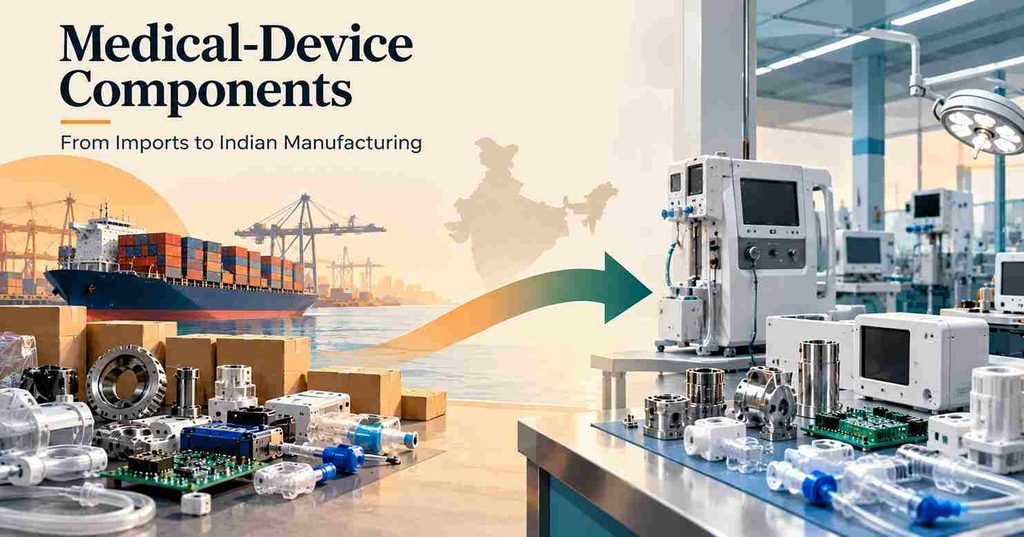
Import Substitution Opportunity 3: Medical-Device Components
Medical devices represent another growing localization area.
India manufactures a wide range of medical products, but components, sensors, precision parts, electronics, specialized plastics and high-value equipment continue to be sourced internationally in several categories.
The opportunity for an MSME may therefore exist below the finished-device level.
A company with expertise in plastics could investigate medical-grade moulded components.
A precision-engineering company could explore surgical or diagnostic equipment components.
An electronics company could study assemblies used inside medical devices.
The potential market should not be considered independently of regulatory requirements.
Medical-device manufacturing often demands stronger traceability, quality assurance, testing and documentation compared with conventional engineering products.
A ₹25 lakh machinery requirement can therefore turn into a significantly larger project once clean manufacturing areas, testing systems, documentation and quality infrastructure are included.
This is why CAPEX should always be calculated after understanding the customer’s technical requirements.
Import Substitution Opportunity 4: Pharmaceutical Intermediates and Industrial Chemicals
India is globally competitive in pharmaceutical manufacturing, yet the industry has historically depended on imported inputs for selected key starting materials, APIs and intermediates.
Government programmes have encouraged domestic manufacturing of critical pharmaceutical inputs, and new capacities have already been established.
However, chemical manufacturing is not automatically an easy MSME opportunity.
The entrepreneur needs to understand:
- Reaction chemistry
- Yield
- Solvent recovery
- Effluent generation
- Hazardous-waste management
- Quality specifications
- Customer qualification
- Utility consumption
- Raw-material sourcing
A chemical intermediate may appear to have strong import demand, but the project could require expensive pollution-control infrastructure.
The attractive opportunity is therefore more likely to suit an existing chemical manufacturer with technical capabilities rather than a completely new entrepreneur choosing a product only from import statistics.
Import Substitution Opportunity 5: Solar and Renewable-Energy Supply Chains
India has added large amounts of solar-generation capacity while simultaneously increasing domestic manufacturing of modules and cells.
As manufacturing grows, opportunities can develop around the supply chain.
However, entrepreneurs should again avoid looking only at the headline product.
Building a solar wafer, cell or module facility may require significant capital.
Smaller manufacturers could investigate:
- Mounting components
- Electrical enclosures
- Cable-management products
- Junction-related components
- Specialized fasteners
- Manufacturing tooling
- Testing fixtures
- Industrial packaging
- Material-handling components
A large manufacturing plant creates demand for hundreds of supporting products.
For an MSME, becoming a supplier to that factory may be more practical than competing with it.
How to Find Import Substitution Opportunities Using Data
A good import-substitution idea should begin with trade data.
India’s official trade databases provide import information based on HS codes. An entrepreneur can study how much India imports, which countries supply the product and how import patterns have changed.
But annual value alone should not be used.
Suppose imports increased from ₹80 crore to ₹150 crore over three years.
That looks promising.
Now check quantity.
If import value increased only because international prices doubled, physical demand may not actually have grown.
The research process should therefore examine:
- Correct HS code
- Import value
- Import quantity
- Major source countries
- Three to five years of historical data
- Domestic manufacturers
- Major Indian buyers
- Typical imported price
- Product specifications
- Manufacturing technology
Only after these ten questions are understood should machinery research begin.
Start With the Buyer, Not the Machine
Many manufacturing projects begin in the wrong sequence.
An entrepreneur discovers a machine online for ₹18 lakh.
The supplier says the machine can manufacture 5,000 pieces per day.
A calculation is made using 5,000 units multiplied by a selling price.
The projected revenue looks attractive.
Then the entrepreneur starts searching for customers.
Import-substitution manufacturing should work in the opposite direction.
Start with the customer.
Find out what Indian buyers currently import.
Understand why they import it.
Ask what would make them purchase locally.
The issue may be price, but it may also be:
- Long delivery time
- High minimum order quantity
- Currency fluctuations
- Expensive international shipping
- Limited after-sales support
- Difficulty obtaining customized products
- Dependence on one overseas supplier
- Long spare-parts lead times
These problems can create opportunities even when an Indian manufacturer cannot beat the international supplier purely on factory price.
Calculating the Real Investment Requirement
There is no standard investment for an import-substitution business.
A project could require ₹10 lakh or ₹100 crore depending on the product.
The investment estimate should usually include:
- Land or rental deposit
- Building modification
- Main manufacturing machinery
- Auxiliary equipment
- Dies and moulds
- Jigs and fixtures
- Testing equipment
- Electrical installation
- Utilities
- Pollution-control equipment
- Material handling
- Quality-control setup
- Installation
- Pre-operative expenditure
- Raw-material inventory
- Working capital
Working capital deserves special attention.
Suppose a manufacturer produces goods worth ₹50 lakh per month and customers pay after 60 days.
The business could have ₹1 crore tied up in receivables before considering raw-material inventory and operating expenses.
A project with ₹40 lakh of machinery can therefore require considerably more than ₹40 lakh to operate properly.
This is why CAPEX and total project investment are not the same.
Government Procurement Can Create Another Market
Government procurement can also support domestic manufacturing opportunities.
Public-sector procurement policies include targets for sourcing from micro and small enterprises, while Make in India procurement rules provide preferences linked with domestic value addition.
This can create opportunities for manufacturers producing standardized industrial goods.
However, government procurement should not be treated as guaranteed demand.
A manufacturer still needs:
- Correct product specifications
- Required certification
- Competitive pricing
- Tender eligibility
- Testing capability
- Production capacity
- Delivery capability
For some products, government procurement may become one sales channel.
It should rarely be the entire business model.
Check Compliance Before Finalizing the Product
One of the easiest mistakes in import-substitution research is ignoring compliance until the machinery has been selected.
Depending on the product, an Indian manufacturer may require factory-related approvals, pollution-control permissions, fire-related approvals and local registrations.
The finished product may also come under specific regulations.
These can include BIS certification, Quality Control Orders, Legal Metrology, medical-device requirements, electrical-safety standards or environmental compliance.
Testing equipment alone can materially affect CAPEX.
Suppose a machine costs ₹30 lakh but mandatory testing infrastructure costs another ₹15 lakh.
Ignoring the testing requirement completely changes the economics of the project.
Compliance research should therefore happen before financial modelling.
Government Incentives Should Come After Commercial Feasibility
India has numerous manufacturing-support programmes.
Electronics, pharmaceutical inputs, medical devices, batteries, automobiles, solar manufacturing, telecom and several other sectors have received policy support.
State governments may additionally offer capital subsidies, electricity-duty benefits, interest subsidies or industrial incentives.
These programmes can improve project economics.
But the factory should not depend on receiving a subsidy in order to survive.
The better sequence is:
First check whether the business works commercially. Then identify which incentives may support it.
Subsidy eligibility, application windows, investment conditions and disbursement periods can change.
They should therefore be considered a supporting factor rather than the core investment thesis.
Major Risks in Import Substitution Manufacturing
Import substitution can sound attractive because demand appears to already exist.
But existing imports do not remove business risk.
The first risk is price competition.
An overseas manufacturer producing 10 million units annually may have a cost structure that a small Indian plant cannot match.
The second is quality.
Industrial buyers may tolerate a 10% price premium for local availability, but they will rarely accept frequent product failures.
Another important risk is customer concentration.
If 70% of expected sales depend on one buyer, losing that customer can seriously affect plant utilization.
Technology can also change.
A component being imported today may disappear from the next generation of the product.
Raw-material prices, currency movements, financing costs and delayed customer payments can further affect profitability.
The purpose of feasibility research is therefore not to prove that an opportunity is attractive.
It is to discover where the opportunity could fail before capital is committed.
Import Substitution Readiness Checklist for MSMEs
Before moving toward plant setup, an entrepreneur should be able to answer:
- What is the correct product and HS code?
- How much does India import annually?
- What quantity is imported?
- Which countries dominate supply?
- Who buys the product in India?
- Why do buyers import instead of buying domestically?
- Who already manufactures it in India?
- What specification do buyers require?
- What is the approximate landed import cost?
- What manufacturing technology is required?
- Are raw materials available domestically?
- What testing equipment is required?
- What regulatory approvals apply?
- What plant capacity is realistic?
- How much working capital is required?
- How long does customer qualification take?
- What happens if selling prices fall by 10%?
- What happens if raw-material cost increases by 15%?
- Can the plant survive at 50% capacity utilization?
- Are potential customers willing to test a locally manufactured sample?
If several of these questions remain unanswered, the project probably needs more research before a DPR is prepared.
Who Should Consider Import Substitution Manufacturing?
Import substitution can be particularly attractive to existing manufacturers.
A precision-engineering company can investigate adjacent imported components.
A plastics manufacturer can examine products currently sourced from China or Southeast Asia.
An electronics assembler can study backward integration into selected components.
An importer may already understand customer demand better than a new manufacturer and could gradually move toward local production.
Family businesses with industrial relationships may also have an advantage because customer access often matters as much as manufacturing technology.
First-time entrepreneurs can certainly explore import substitution, but they need deeper customer validation.
The worst sequence is:
Buy machine – rent factory – manufacture product – search for customer.
A healthier sequence is:
Study imports – identify buyers – understand specification – test demand – evaluate technology – estimate investment – develop samples – validate economics – prepare DPR – invest.
Final Thoughts
India’s large import bill creates thousands of possible research ideas, but only a fraction will become practical manufacturing projects.
The most interesting opportunities for MSMEs may not be the products receiving the biggest headlines.
They may be a ₹900 industrial connector, a ₹12,000 machined component, a ₹35,000 medical-device assembly or a specialized replacement part that hundreds of Indian companies currently wait weeks to import.
That is why import substitution should be approached product by product.
Study what India imports.
Then go deeper.
Find the buyer.
Understand why the product is imported.
Check whether Indian manufacturing can realistically solve the buyer’s problem.
Compare domestic production cost with landed import cost.
Verify machinery, raw materials, quality requirements, working capital and compliance.
Only then should an entrepreneur decide whether the opportunity deserves a detailed feasibility study or DPR.
For an Indian MSME, import substitution is not simply about replacing a foreign product.
It is about building a domestic manufacturing capability that customers are genuinely willing to use.
📊 Want to Explore an Import Substitution Manufacturing Opportunity?
Start with an opportunity study before committing capital.
A Green CapEx Opportunity Report can help examine the import market, domestic manufacturing gap, customer base, machinery requirement, indicative investment and major project risks.
Once the product and capacity are clear, the opportunity can move toward a Standard DPR or a detailed Custom DPR.
Discover. Research. Evaluate. Plan.